Let’s run a quiet calculation most homeowners never make.
Not mortgage.
Not utilities.
Not association dues.
Flood stress.
If you’ve lived in parts of Cainta or Marikina, you know the routine. The rain starts. Group chats light up. Someone sends a photo of rising water. You check the weather app. You move the car. You cancel plans.
It doesn’t feel expensive.
But it is.
The Hidden Cost Breakdown
Let’s assume just 10 heavy rain days a year where mobility becomes uncertain.
On each of those days:
• 1–2 hours monitoring conditions
• 1 hour adjusting plans or rerouting
• 1–2 hours delayed commute
Conservatively, that’s 3 hours lost per incident.
10 incidents x 3 hours = 30 hours a year.
That’s almost four full workdays.
Now add the invisible costs:
• Missed meetings
• Cancelled family dinners
• Stress spikes
• Sleep disruption
Flood stress doesn’t just take time.
It drains energy.
Drift vs Shift
Drift
You wake up to dark clouds and immediately check river levels.
You calculate alternate exits.
You debate whether to leave earlier or later.
Your entire day is shaped by uncertainty.
Shift
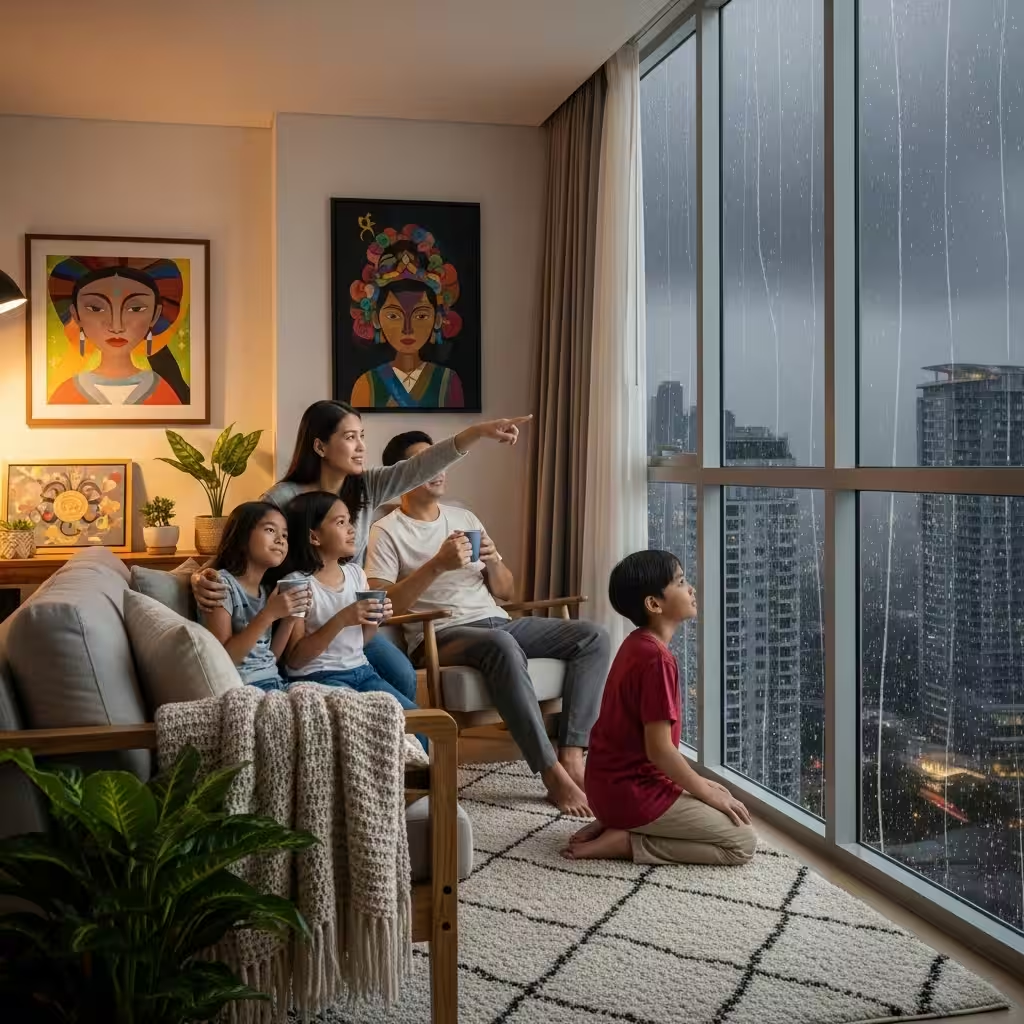
You live in a high-rise along Calle Industria in Quezon City.
C5 is 0.25 km away. Ortigas Ave is 0.65 km away.
Major townships are minutes from you.
You’re elevated. Central. Connected.
Instead of checking flood updates, you check your calendar.
The psychological difference is enormous.
Because here’s the truth:
Predictability is productivity.
When your home is near key business districts —
4.6 km to Pasig
5.5 km to Ortigas
9.2 km to BGC
— you remove layers of risk from your week.
And when your building includes:
• 24/7 security
• Integrated CCTV
• Backup power for emergency loads
• Property management and maintenance
You’re not managing crises alone.
You’re supported.
Time-Wealth in 2026
Thirty reclaimed hours a year isn’t dramatic.
Until you visualize it.
That’s:
• 15 extra gym sessions
• 10 unrushed dinners
• 6 full movie nights
• Or simply 30 evenings without tension
We often compare houses by size.
We rarely compare them by stability.
But in a climate where heavy rains are becoming more common, resilience isn’t a luxury.
It’s strategy.
So here’s the question:
If you could reclaim 30 calm hours every year —
What would you use them for?